





According to the World Bank, people with special needs constitute an estimated 6-8% of the Indian population, more than double the number projected by the 2001 census[1]. Children with special needs are statistically more likely to be out of school, adults with disability have high rates of unemployment and in general, the quality of life of a person with special needs is significantly lower than the general population[2]. Disability prevents most people in India from reaching their potential and leading productive, fulfilling lives. In addition to stunting individuals, it also affects families which suffer significant losses in productivity and in their own ability to lead fulfilled lives.
Services for people with disabilities are remarkable by their absence. Those that do exist are difficult to access and are not well-publicized.
80% to 90% of persons with disabilities of working age are unemployed. In 2006, the Minister of Social Justice and Empowerment of the Government of India released the National Policy on Persons with Disabilities[3]. Indicating our country’s commitment to improve the lives of those with disabilities, the report encompasses a fifteen year plan that details the issuing of disability certificates, provision of early intervention services, social security schemes and strategies to improve employment prospects. This report, together with India’s signing of breakthrough national and international legislation, demonstrates that the country at least has a stated commitment to promote the rights of people with disabilities and to move closer to an inclusive society. Employment and livelihoods, as well as the larger issue of GDP and economic growth, is a big political agenda of all political parties.
Introduction
Latika works with children and young adults with developmental disabilities, and their families. Founded in 1994 in Dehradun, a city in the foothills of Himalayas. Latika provides comprehensive services across the entire age span – through six centers.
Latika Training is one of the six centers. It offers young adults with developmental disabilities (14-21 years) support in adolescence, a structured curriculum on a strong sense of self and focused skill development. There are two separate streams – skill development and social/recreational – though they overlap in significant ways. In the skill development stream the following is taken into consideration.
- A structured and comprehensive pre-vocational and vocational programfor young adults with potential for employment in kitchen, craft, housekeeping, tailoring, office assistant skills, artistic endeavors, packing and assembly.
- Functional academic skills to teach young disabled adults the concepts of finance, time, road safety, measurements, accessing public transportation, using devices.
Personal development for activities of daily living and lifelong lessons in dealing with their emotional world,
[1] 1 World Bank report published in 2007 “People with Disabilities in India: from commitments to outcomes”
[2] Iemmi V, Kumar KS, Blanchet K, Gibson L, Hartley S, Murthy GVS, Patel V, Weber J, Kuper H. Community‐based rehabilitation for people with physical and mental disabilities in low‐ and middle‐income countries. Cochrane Database Syst Rev. 2017 Mar 2;2017(3):CD010617. doi: 10.1002/14651858.CD010617.pub2. PMCID: PMC6464564.
[3] Kumar SG, Roy G, Kar SS. Disability and rehabilitation services in India: issues and challenges. J Family Med Prim Care. 2012 Jan;1(1):69-73. doi: 10.4103/2249-4863.94458. PMID: 24479007; PMCID: PMC3893941.
disability certificates, provision of early intervention services, social security schemes and strategies to improve employment prospects. This report, together with India’s signing of breakthrough national and international legislation, demonstrates that the country at least has a stated commitment to promote the rights of people with disabilities and to move closer to an inclusive society.Employment and livelihoods, as well as the larger issue of GDP and economic growth, is a big political agenda of all political parties.
Introduction
Latika works with children and young adults with developmental disabilities, and their families. Founded in 1994 in Dehradun, a city in the foothills of Himalayas. Latika provides comprehensive services across the entire age span – through six centers.
Latika Training is one of the six centers. It offers young adults with developmental disabilities (14-21 years) support in adolescence, a structured curriculum on a strong sense of self and focused skill development. There are two separate streams – skill development and social/recreational – though they overlap in significant ways. In the skill development stream the following is taken into consideration.
- A structured and comprehensive pre-vocational and vocational programfor young adults with potential for employment in kitchen, craft, housekeeping, tailoring, office assistant skills, artistic endeavors, packing and assembly.
- Functional academic skills to teach young disabled adults the concepts of finance, time, road safety, measurements, accessing public transportation, using devices.
Personal development for activities of daily living and lifelong lessons in dealing with their emotional world, developing good relationships and leisure activities, protecting themselves sexually, and understanding appropriate behavior.
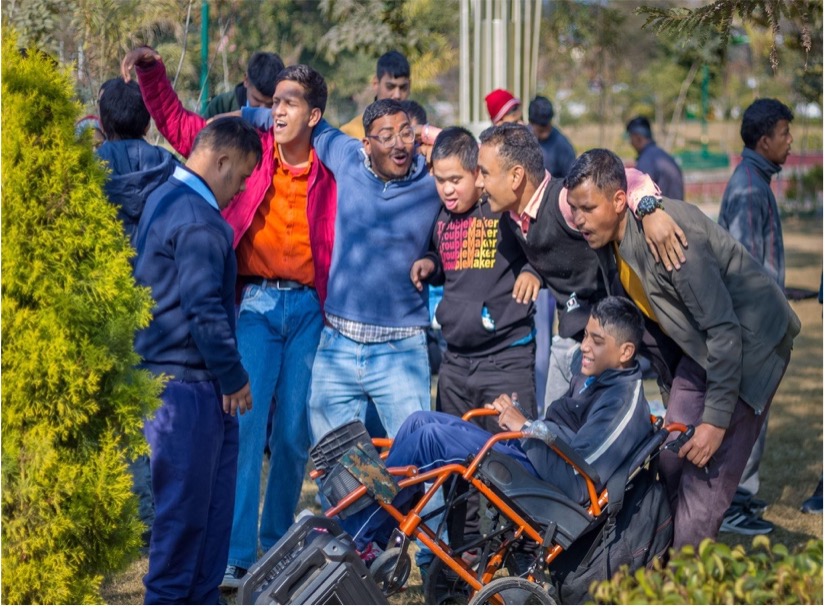
In the social/recreational stream, occupational therapy, physical therapy, personal self-help skills, art, music, and the development of leisure activities are combined for each person, taking into account their interests, abilities, and home environment.
Latika Training Team
There are 95 trainees presently, and each trainee has a unique plan with Specific, Measurable, Achievable, Replicable and Timebound (SMART) objectives developed in consultation with the individual and her/his family and reviewed quarterly. Immersive experiences, such as field trips and internships, are essential components of the programme. Through careful, targeted skills training, enhanced by community outreach, and workplace sensitization, the project assists adults with disabilities to be economically and socially included in the community.
People with intellectual impairment, abstract concepts are often meaningless, activity-based learning (ABL) is the only way. Therefore, teaching methods are activity based because that is the only way to learn. Equally important, ABL is fun.
At Latika Training, the aim is empowering young disabled adults and their families while creating enabling environments – moving from exclusion to access and isolation to community. Individual professional development plans for trainees with cognitive difficulties are developed, based on their strengths and interests.
The interdisciplinary team builds and enhances functional and vocational skills in trainees through training, communication, therapy and education. Mental healthcare is an integral part of the services.
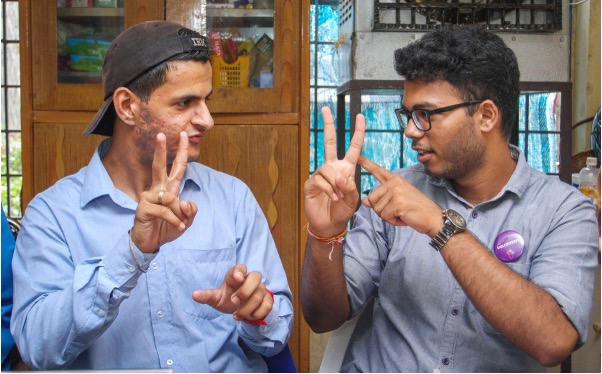
With the help of individualized plans and skill training the trainees are not only trained but able to navigate barriers and challenges they may foresee as new employees. The team provide practical insights and simple adaptations that will help them in managing their employment. As the trainees grow and learn the staff also works closely with targeted employers to help them implement and enhance their practices for an inclusive workforce. Success is measured both in terms of securing meaningful, safe, fair employment and living a healthy (at all levels – physically, emotionally, socially) and happy life.
Conclusion
Data on persons with disabilities are hard to come by in almost every country. Specific data on their employment situation are even harder to find. Yet persons with disabilities face the same predicament everywhere. These data, culled from the media and from reports, provide an anecdotal picture of the current situation. While individuals with disabilities can make valuable contributions in community work places, they typically experience challenges in low rates of paid employments on being included in same social and ability parameters[1]. People with disabilities can contribute they need understanding, support and opportunities not charity or misplaced sense of compassion.