




“Independence in radiology is preserved through disciplined data, operational precision, and informed negotiation. We ensure radiologists are paid appropriately for the care they provide and to help practices see their business clearly enough to lead from strength.”
Radiology sits at the crossroads of modern healthcare. It touches nearly every patient journey, yet the practices delivering imaging services are operating under relentless financial and operational pressure. Reimbursement rates continue to tighten, administrative requirements grow more complex each year, and a larger share of revenue is now tied directly to patient responsibility. At the same time, radiology groups are expected to maintain clinical excellence, invest in technology, and preserve their independence in a rapidly consolidating market.
For its nationally scaled performance, radiology- exclusive focus, executive-led service model, and disciplined innovation, PBS Radiology has been named RCM Company of the Year—an honor that reflects operational excellence and measurable impact across radiology practices nationwide.
Built by Radiology Leaders, for Radiology Leaders
Unlike many revenue cycle vendors that serve multiple specialties, PBS Radiology is independently owned and dedicated exclusively to radiology. That distinction is foundational.

The company was shaped by executives who have led healthcare organizations from the inside, negotiating hospital contracts, aligning physician compensation models, and managing large-scale revenue cycle operations. That operational foundation informs every client engagement.
In a recent conversation with Nicole Jones-Gerbino, President and co-owner of PBS Radiology, we discussed how practices across the country are navigating pressures and why revenue cycle performance has become central to sustainability.
Jones-Gerbino serves on the executive leadership team focused on execution, performance, and long-term client outcomes. With nearly two decades focused on radiology operations, she understands the financial and operational pressures radiology groups face through direct experience inside healthcare administration. While not a clinician herself, she speaks with deep respect for those on the front lines of patient care and a clear understanding of the pressures radiologists face.
“Every transaction we touch represents a patient,” she explains. “Our role is to make sure the non-clinical side of care supports, rather than distracts from, the work physicians are doing every day.” That perspective shapes PBS Radiology’s operating philosophy, even as its core focus remains revenue performance.
The challenges facing radiology groups are financial as much as operational. Medicare reimbursement for physicians has declined significantly over the past two decades when adjusted for inflation, while the cost of delivering care continues to rise. Payers have tightened policies and increased prior authorization requirements. High-deductible health plans have shifted financial responsibility to patients, making patient collections a critical revenue component rather than a secondary one. Layered on top of this are ever-expanding compliance mandates, quality programs, and cybersecurity risks.
PBS Radiology was built to address these pressures through a comprehensive, end-to-end revenue cycle model grounded in scalability and strategic oversight. Services include billing, coding, credentialing and enrollment, patient financial services, quality reporting, payer strategy, hospital negotiation support, and executive advisory services.
Their national infrastructure allows them to scale rapidly across markets, onboard practices operating in multiple states, and adapt without disruption. That scalability has enabled PBS to support complex radiology groups that require both operational precision and strategic oversight.
“What differentiates us is that we understand how revenue behaves inside a radiology practice,” Jones-Gerbino says. “We are not just processing claims. We are analyzing payment patterns, identifying revenue risk, and helping practices adjust in real time.”
Revenue exposure is addressed upstream before claims are submitted. Structured workflow oversight and predictive analytics identify documentation gaps, coding inconsistencies, and payer-specific vulnerabilities early enough to prevent downstream disruption. The result is cleaner claims, stronger collections, and greater financial predictability.
A Framework for Financial Strength
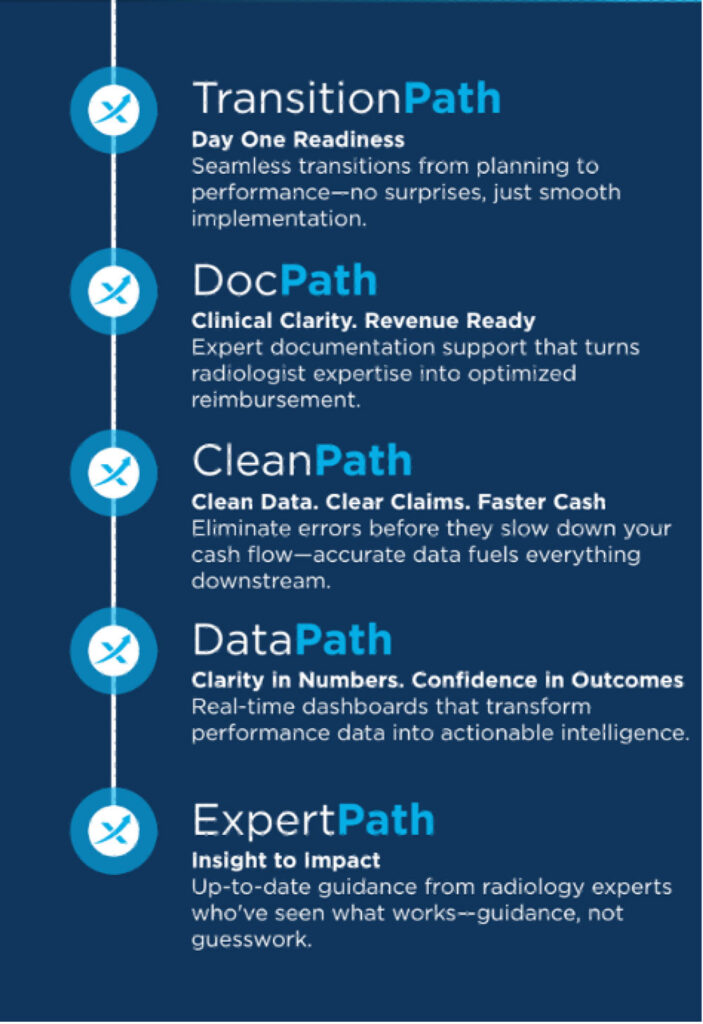
Central to PBS’s impact is its defined performance framework known as The PBS PATH, a structured model designed to create consistency, visibility, and strength across the revenue cycle.
Together, these pathways create cleaner data, clearer decisions, and stronger revenue performance. As one PBS client CEO summarized, “PBS doesn’t just tell us what happened, they help us understand why and what to do next.”
Balancing Technology with Human Expertise
Technology plays a critical role in modern revenue cycle management, but PBS treats it as an enabler, not a replacement for expertise.
The company utilizes an industry-leading radiology billing platform enhanced by PBS’s proprietary tools and advanced technology that improve data quality, streamline workflows, and accelerate reimbursement. Advanced business intelligence capabilities provide deep visibility into payer trends, denial categories, reimbursement shifts, and performance variances.
Importantly, technology at PBS is always paired with interpretation and strategy. Insights are translated into operational recommendations, education, and executive decision-making support.
As patient responsibility grows, financial engagement strategies have also evolved. PBS designs processes that reduce friction while preserving access to real human support. Patients can interact digitally via text, email, or online statements, while trained representatives remain accessible for conversations that require empathy and clarity.
“Automation has a role,” Jones-Gerbino notes, “but healthcare billing often requires empathy and real dialogue. We make sure patients can access both.”
This philosophy reflects a broader cultural commitment inside PBS: operational precision without losing sight of the patient experience.

Data Governance, Compliance, and Security
As revenue cycles grow more digitized, compliance and cybersecurity are no longer secondary concerns, they are foundational. PBS maintains rigorous data governance standards and is SOC 2 Type II compliant, working exclusively with vendors that meet equivalent security thresholds.
“We are entrusted with sensitive patient and financial information,” Jones-Gerbino explains. “That responsibility shapes how we build, how we partner, and how we scale.” This disciplined infrastructure allows PBS to support complex, multi-state radiology groups operating across varied landscapes without compromising security or performance.
Preserving Independence Through Clarity
The consolidation of healthcare continues to accelerate. Private equity investment, hospital acquisition, and national platform growth have reshaped the competitive landscape. Independent radiology groups must operate with greater financial sophistication than ever before. Clear data is power. When practices understand revenue at depth, they negotiate, evaluate, and compensate differently. PBS believes that when practices truly understand their numbers, they lead differently, as clarity protects margin and preserves independence.
As an independent organization, PBS retains flexibility and scalability. Technology innovation and operations are guided by operational need and client performance rather than external investor pressure.
PBS Clients note that working with leaders who have held senior roles within radiology practices themselves makes a meaningful difference. Beyond daily operations, PBS maintains active engagement in national and regional radiology organizations, contributing insight on reimbursement trends, regulatory shifts, workforce pressures, and industry consolidation. Clients benefit from early awareness of policy and market changes that could impact their business.
Radiology remains central to healthcare delivery. By raising the standard in revenue cycle management, PBS Radiology strengthens the infrastructure that allows independent radiology practices to compete, grow, and thrive.
For independent groups determined to lead from strength rather than react from pressure, PBS has become more than a vendor. It is a strategic partner. And in a year defined by complexity, performance, and transformation, that partnership has set the benchmark for the industry.
Copyright © 2026. All Rights Reserved. Healthcare Business Outlook.